PSLE Oral Guide · 2025–2026
The Parent's Guide
to PSLE Oral
Everything Singapore parents need to know about both PSLE oral exams — the 2025 English Oral overhaul (PACT, photograph stimulus, opinion-only conversation) and PSLE Chinese Oral (topics, scoring, 多音字, home practice). Written for English-dominant families.
English Oral
Chinese Oral
of exam data

PSLE English Oral
The 2025 overhaul: PACT, photograph stimulus, opinion-only conversation, and the new pronunciation rubric.
What is the PACT framework in PSLE English Oral?
PACT — Purpose, Audience, Context, Tone — is the new preamble at the top of every Reading Aloud passage from 2025. The student is expected to actively colour their reading to match.
How should my child analyse the photograph in PSLE English Oral?
5W1H — Who, What, Where, When, Why, How — is the simplest checklist for the 5-minute prep window. The first three are observation, the last three force the inference skill the 2025 rubric rewards.
Which pronunciation mistakes cost the most marks in PSLE English Oral?
Six recur in almost every Singapore student — dropped ending consonants, flattened 'th', dropped past tense, collapsed vowels, reading too fast, and reading every passage in the same flat voice.
How should my child practise PSLE English Oral at home?
20 minutes a day — 10 minutes Reading Aloud with PACT decoding, 10 minutes Stimulus-Based Conversation using 5W1H for photograph prep and PEEL for the spoken answer.
Both Languages
Cross-language guides on the answer structures, scoring, and topic patterns that transfer between Chinese and English Oral.
Why are memorised answers failing in PSLE Oral — both languages?
SEAB has reshaped both conversation components to defeat memorised model answers. English removed sub-prompts in 2025; Chinese examiners have been asking 你同意吗 since 2023.
What PSLE Oral topics have appeared over the last decade?
Eleven years of reported topics across both subjects, in one searchable database. Five theme clusters appear in both exams — preparation gains transfer across languages.
What is the P.E.E.L. framework and how does it help in PSLE Oral?
Point, Explain, Example, Link — a four-step answer structure that works for both PSLE Chinese Oral opinion questions and the post-2025 English Oral Stimulus-Based Conversation.
How do PSLE English and Chinese Oral compare on marks and rubrics?
After the 2025 English overhaul, the two orals are worth 90 marks combined — 40 for English, 50 for Chinese — and share the same five core scoring dimensions.
PSLE Chinese Oral
Topics, scoring, 多音字, 你同意吗, and home-practice routines — written for English-dominant Singapore parents.
How can I help my child if I don't speak Chinese?
You can train the structural habits PSLE examiners reward — in English, around the kitchen table. Three questions after every answer is the highest-leverage technique.
What does 你同意吗 mean and why does it matter?
你同意吗 (nǐ tóngyì ma) means 'Do you agree?' Since around 2023, examiners frame conversation questions as opinion challenges that defeat memorised templates.
What topics will appear in PSLE Chinese Oral 2026?
Based on 9 years of exam data, the highest-probability themes for 2026 are technology/screen time, community care, and environmental responsibility.
Why are memorised Chinese answers failing in 2025?
SEAB examiners now ask 你同意吗 (Do you agree?) — a format that cannot be answered with a memorised template. In 2025, this format was confirmed on Day 1 across 60+ schools.
How is PSLE Chinese Oral scored? What do the 50 marks mean?
50 marks total: 20 for reading aloud, 30 for conversation. The biggest differentiator between AL1 and AL3 is answer depth, not pronunciation.
Does the reading passage match the conversation video?
The SEAB Chinese syllabus is silent on whether the two components share a theme — there is no official guarantee. SEAB explicitly decoupled the English oral in 2025.
What are 多音字 and which ones matter for PSLE?
Polyphonic characters with multiple pronunciations. The highest-priority ones for PSLE are 得, 的, 地, 着, 为, 还 — they appear in almost every reading passage.
How should my child practise PSLE Chinese Oral at home?
20 minutes a day — 10 minutes reading aloud, 10 minutes conversation practice from the high-frequency theme bank. Even non-Chinese-speaking parents can coach the structure.
Is Chinese oral tuition worth it, or is self-practice enough?
Tuition runs S$150–350/month in Singapore but only gives 5–10 min of active speaking per class. Daily home practice delivers more reps — and the hybrid beats either alone.
What are the top PSLE Chinese Oral tips for 2026?
Ten high-leverage tips from nine years of exam data — PEEL answer structure, 多音字 drilling, 你同意吗 preparation, the 20-minute daily routine, and what separates AL1 from AL3.
How PSLEPrep Scores
What our AI examiner actually measures, dimension by dimension — for both Chinese and English Oral.
How does PSLEPrep score PSLE English Oral?
Microsoft Azure Speech for Reading Aloud (15 marks) and AI-scored conversation for the three opinion questions (25 marks) — aligned to the post-2025 SEAB rubric.
How does PSLEPrep score PSLE Chinese Oral?
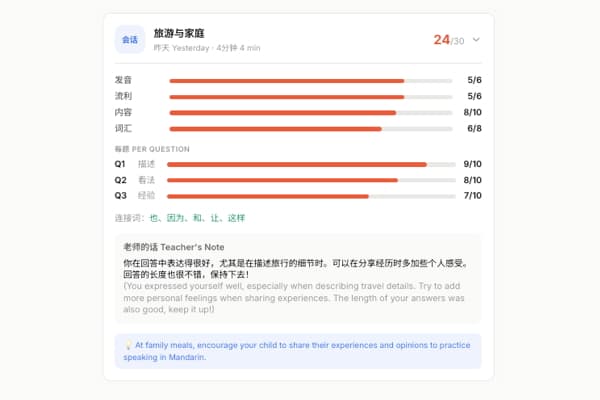
Audio analysis for pronunciation and AI language understanding for content — matching the PSLE examiner's four dimensions on the 50-mark rubric (20 reading + 30 conversation).
Who is this guide for?
This guide is written for Singapore parents whose children are preparing for PSLE Chinese Oral, PSLE English Oral, or both. If you're trying to make sense of the 2025 English Oral changes, can't read Chinese tutor blogs, and don't know what your child is being tested on — these articles are for you.
Every article is in English, with Chinese terms explained in context. The advice is research-backed — sourced from SEAB syllabus documents, published tuition centre analyses, and 9 years of publicly reported exam data.
About PSLEPrep
AI-powered PSLE Oral practice your child can do alone.
PSLEPrep covers both PSLE oral exams with an AI examiner that scores reading and adapts to your child's conversation answers — just like the real exam. S$29.90/month. No parent involvement required.